Courses on Telegram
To sell courses on Telegram is to sell in the messenger where the students already are — no learning platform login, no "check your email for the link", just the channel they read anyway and a storefront three taps away. This page covers how course sellers run here today: the course as a product, paid access, and the honest line between what the platform runs and what your channel runs.
Courses as products
The mechanics: each purchasable unit is a product card in the catalog.
- The flagship course — one card, the full program, priced in one payment (or as the first block of a payment plan via variants).
- Modules and intensives — separate cards for the pieces that sell standalone; the "start here" cheaper module is the classic funnel into the flagship.
- Consultation and review add-ons — the hour of homework review or the onboarding call, sold as service products beside the content.
- The description carries the syllabus — modules, outcomes, format, time commitment: the landing-page copy lives on the card, where the checkout button already is.
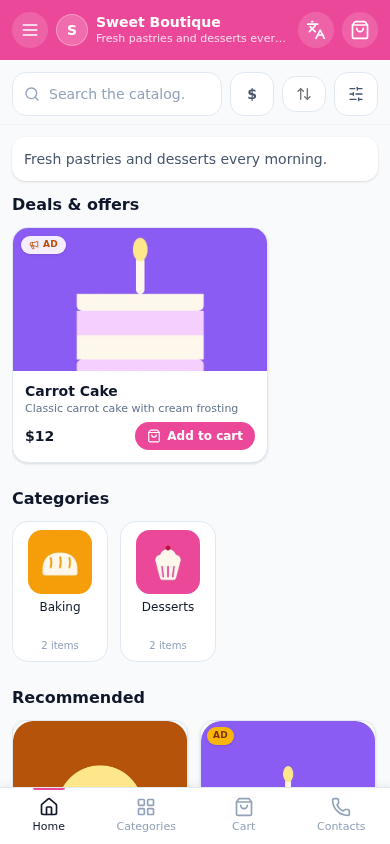
Categories split the school's shelf ("Courses", "Intensives", "Consultations"), and the promo carousel flags the open-cohort course to the storefront's first screen during enrollment week.
Paid access and delivery
The honest division of labor today:
- Payment is automatic — the buyer pays in Stars (a course consumed inside Telegram is a digital good; the take is ~35%, priced in via the divide-by-0.65 rule) or by card rail for hybrid/offline programs.
- Access is granted by the seller — the paid order lands in the cabinet with the buyer's contact; granting channel/group access is an invite. For cohorts this is a feature, not a chore: the enrollment list is the order history, and the invite is the welcome ritual.
- The receipt link is the student's proof of purchase — what they bought, what they paid, the reference for any support question.
- Content delivery lives where it always did — the private channel, the chat, the sessions. The platform runs the store and the money; the school runs the teaching.
On the roadmap: drip schedules (lesson N unlocks on day N), homework flows and automatic access provisioning. Today's honest pattern — enrollment list from orders, invites by hand, content in the channel — scales comfortably into hundreds of students, because the cabinet's order history IS the roster.
Pricing: one-time vs subscription
| Model | Fits | Mechanics |
|---|---|---|
| One-time course | flagship programs, evergreen content | single card, full price |
| Cohort enrollment | live programs with start dates | card flagged to the carousel during the window |
| Subscription | monthly masterminds, rolling access | re-purchasable monthly card |
| Module ladder | funnel courses | standalone modules, each a card |
Two pricing notes from the field: price the Stars rail in from the start (the digital products page has the full math and the AML boundaries — course content is digital content); and keep a free module or a cheap intensive as the top of the funnel — the buyer who paid 9.90 once converts to the flagship at many times the rate of a cold visitor.
What the channel does
The course business on Telegram is a three-surface machine: the public channel (the free content that sells the paid thing), the storefront (the catalog, the checkout, the receipts) and the private channel (the paid content itself). The how to sell on Telegram guide covers growing the first surface; this platform runs the second; the third is why students stay.
Start with the free plan: one course, one card, one payment rail, the enrollment rehearsal done with a test order — then the first cohort sells the second.
Live demo
FAQ
Related pages
Create your Telegram shop in 10 minutes
Free plan, no credit card. Add products, share the link in your channel and take orders.
Start for free